
For Parents
You Do Not Need To Be A Perfect Parent
Children do not need perfect parents. They need adults who are willing to learn, listen, repair, and reconnect.
Many parents today are carrying emotional pressure of their own while also trying to support their children.
BCHBH offers simple emotional awareness tools that help families create more safety, understanding, and connection at home.
Starting With Yourself
Children Feel What We Carry
Children often sense emotional pressure long before adults speak about it.
Stress, frustration, exhaustion, anxiety, and overwhelm can quietly affect family relationships.
BCHBH encourages parents to begin with gentle self-awareness.
When adults learn to notice their own emotional state, children naturally feel safer and more supported.
When Your Child Is Struggling

When children become angry, withdrawn, anxious, or overwhelmed, they are not asking for punishment.
They are often asking for support.
Instead of asking:
“What is wrong with this child?”
BCHBH encourages families to ask:
“What might this child be experiencing right now?”
This small shift can transform the entire conversation.
The Power Of Listening
Children do not always need solutions immediately.
Often they need:
When children feel heard, emotional pressure often begins to soften naturally.
Repair Is More Important Than Perfection
Every parent loses patience sometimes.
Every family experiences difficult moments.
Healthy relationships are not built through perfection.
“They are built through repair.”
A simple:
“I'm sorry.”
or
“Let's try again.”
can teach children more about emotional resilience than any lecture.

Growing Together
BCHBH is not only for children.
It is a shared journey for parents, caregivers, teachers, and families.
As emotional awareness grows in adults, children naturally learn the same skills through daily life.
A Gentle Word To Parents
You Don't Need To Be Perfect
No parent gets everything right.
Children do not need perfect parents.
They need adults who are willing to listen, learn, and stay present.
BCHBH is not about blame.
It is about understanding what is happening inside a child and responding with greater awareness and compassion.

Listening Before Fixing
Sometimes Children Need Understanding More Than Solutions
When children are upset, adults often rush to correct, advise, or solve.
Sometimes the most helpful response is simply:
“Tell me more.”
Listening helps children feel safe.
And children who feel safe are more able to understand their own emotions.
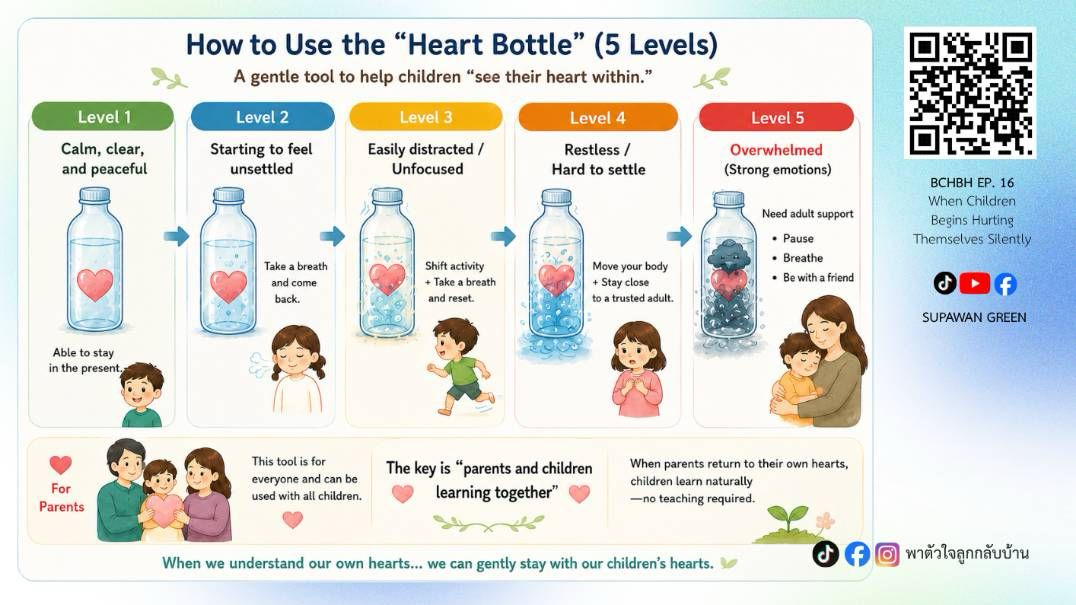
The Heart Bottle At Home
Using The Heart Bottle Together
Children often find it easier to talk about emotions when they have simple language and visual tools.
Parents can ask:
- How full is your Heart Bottle today?
- What added water to your bottle?
- What helped your bottle feel lighter?
The goal is not to judge emotions. The goal is to notice them together.
When Big Emotions Appear
Anger Is Not The Enemy
Anger, sadness, fear, jealousy, and frustration are all part of being human.
Children do not need to suppress emotions. They need safe ways to understand and express them.
Every emotion can become a teacher.
Five Minutes Can Make A Difference
A few minutes of calm attention each day can strengthen connection. You might:
What matters most is not the activity. It is the quality of attention.
A Message Of Hope
Children Grow Through Connection
No child is broken.
No family is beyond help.
When children feel seen, heard, and understood, they begin to find their way home again.
And often, parents discover something important about themselves along the way.
Next: For Teachers
Teachers play a vital role in a child's emotional world. The next section explores how emotional awareness can be gently integrated into classrooms and learning environments.
Explore Teacher Support →